The complete guide to dealer management in poker tournaments
Managing dealers is one of the hardest parts of a multi-table tournament. How to schedule rotations, handle breaks and keep your floor running smoothly.
Your blind structure is dialed in. The tables are set. Players are registering. Everything looks perfect, until you realize Table 3 has been without a dealer for ten minutes, Table 7's dealer hasn't had a break in three hours, and nobody can remember who was supposed to push where after the color-up. Sound familiar?
Dealer management is the unglamorous backbone of every well-run poker operation. Players notice the clock, the felt, and the prize pool, but behind every smooth event is a floor manager who nailed the dealer rotation. Get it wrong, and the whole night unravels. Get it right, and nobody even thinks about it.
This guide covers everything you need to know about managing dealers effectively, whether you're coordinating two dealers at a weekly home game or running a twenty-table tournament. We'll break down the key components, common mistakes, and how modern tools can eliminate the chaos.
Why dealer management matters more than you think
Here's the thing most new organizers learn the hard way: dealer problems don't stay dealer problems. A missed rotation means one table plays faster than the others. A dealer who hasn't had a break starts making mistakes: miscounting pots, dealing to eliminated seats, slowing down. Players notice, they get frustrated, and frustrated players don't come back next week.
For poker clubs and regular game organizers, player retention is everything. Your regulars have options: other clubs, home games, online poker. The experience you deliver determines whether they keep showing up. And a surprising amount of that experience comes down to how well your dealers are managed, rested, and informed.
The best-run poker rooms in the world don't have better dealers. They have better systems. A great rotation schedule turns an average dealer into a reliable one, and a bad schedule turns a great dealer into a liability.
The traditional approach (and why it breaks down)
Most poker clubs start with some version of the same system: a whiteboard, a spreadsheet, or a group chat. The floor manager writes down dealer assignments at the start of the night, maybe sets a phone timer for rotations, and tries to keep track of breaks in their head. For a two-table game with two dealers, this works fine. The problems start when you scale.
Pain points that every floor manager recognizes
- The mental juggling act: tracking who's dealing where, who's due for a break, and who's next in the rotation, all while handling player disputes and table balancing. It's too much for one brain.
- Communication breakdowns: telling a dealer to move to Table 5, but they didn't hear you over the chip shuffling. Or sending a WhatsApp message that gets buried. Information gets lost.
- No single source of truth: the whiteboard says one thing, the spreadsheet says another, and the floor manager's memory says something else. When things get hectic, nobody knows what's current.
- Break management chaos: one dealer takes a longer break than planned, which cascades through the entire rotation. Suddenly you're scrambling to cover tables.
- Inconsistent dealing time: without tracking, some dealers deal for ninety minutes straight while others get frequent breaks. This creates fatigue, errors, and resentment.
- The new floor manager problem: when your regular floor manager calls in sick, all that institutional knowledge disappears. The backup has no idea what the usual rotation looks like.
In a survey of poker club operators, dealer coordination was cited as the single biggest operational headache, ahead of player disputes, prize pool calculations, and even marketing. Yet it's the area where most clubs invest the least in tooling.
The four pillars of effective dealer management
Whether you're running a casual weekly game or a multi-day poker festival, effective dealer management comes down to four core components. Master these, and everything else falls into place.
1. Table assignments & rotations
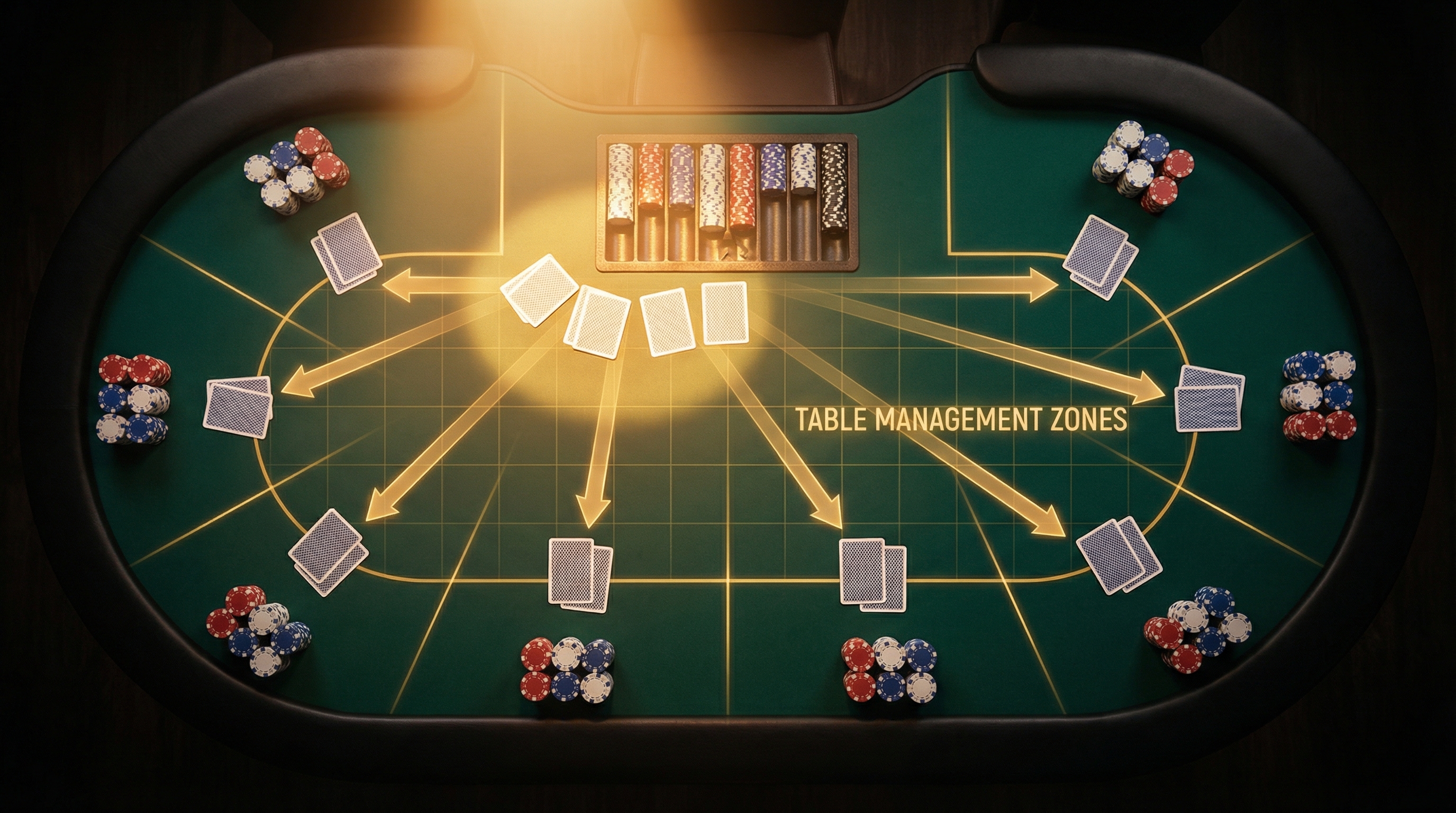
The foundation of dealer management is knowing exactly who should be at which table, and when they should move. A well-designed rotation ensures even distribution of dealing time, prevents any dealer from sitting at the same table too long, and keeps the pace consistent across all tables.
Most professional operations rotate dealers every 30 to 45 minutes. Shorter rotations keep dealers fresh but create more transitions. Longer rotations reduce disruption but increase fatigue. The sweet spot depends on your game type: tournaments benefit from quicker rotations since dealers need to stay sharp for level changes, while cash games can run longer.
- Set a fixed rotation interval and stick to it, because consistency matters more than perfection
- Rotate in one direction (clockwise through table numbers) so dealers always know where they're going next
- Build in a "dead push" position where possible, a slot in the rotation where the dealer is on standby rather than dealing, giving them a mental breather without a full break
- Never rotate mid-hand: wait for the current hand to complete before the push
2. Break scheduling
Dealers need breaks, and not just because labor laws say so. Mental fatigue leads to dealing errors: wrong cards exposed, missed antes, incorrect pot calculations. A tired dealer is a slow dealer, and slow dealing frustrates players. The challenge is scheduling breaks without leaving tables uncovered.
The standard approach is to have one more dealer than you have active tables. This "extra" dealer is your break relief. In a six-table tournament, you'd ideally have seven dealers: six dealing and one on break at any given time. When that's not possible (and it often isn't at smaller operations), you need to get creative.
- Sync dealer breaks with tournament breaks when possible, and use that window to reset your rotation
- Stagger breaks so no more than one dealer is off at any time. Never leave two tables uncovered simultaneously
- Track actual break times, not just scheduled ones. This helps you plan the rest of the night accurately
- Set clear expectations: break length, where to wait when their break ends, and how to signal they're ready to return
3. Communication & coordination
In a loud poker room with chip shuffling and animated table talk, verbal communication is unreliable. The floor manager shouldn't have to walk to each table to tell dealers where to go. Group chats become noisy and get ignored. You need a communication channel that's instant, visual, and impossible to miss.
The gold standard is a system where every dealer can see their current assignment, their next assignment, and their break schedule on a device in front of them. When the floor manager makes a change, every dealer sees it immediately. No shouting, no walking around, no ambiguity.
4. Shift planning & scheduling
The work starts before the first card is dealt. Knowing how many dealers you need, when they should arrive, and how long their shifts should run is critical. Understaffing means exhausted dealers and uncovered tables. Overstaffing means wasted payroll.
- Plan for one dealer per table plus at least one backup, and more for tournaments expected to run 6+ hours
- Consider dealer skill levels when assigning: put your most experienced dealers on final tables and high-stakes games
- Build your schedule around your tournament structure: if you know tables will consolidate after 4 hours, plan shift ends accordingly
- Keep a list of on-call dealers who can fill in for no-shows. Last-minute cancellations happen, and scrambling for coverage is stressful
How modern tools change the game
For decades, dealer management was a purely manual operation: clipboards, walkie-talkies, and institutional knowledge locked in one floor manager's head. That worked when poker rooms were smaller and events were simpler. But as the scene has grown, the manual approach has hit its ceiling.
The shift to digital dealer management isn't about replacing the floor manager's judgment. It's about giving them better tools. They still decide the rotation strategy and handle the judgment calls. But instead of juggling logistics in their head, they have a system that handles scheduling, communication, and tracking automatically.
What good dealer management software looks like
- Real-time table assignments that sync instantly to every dealer's device, with no delays, no refreshing and no missed messages
- Visual rotation overview showing the floor manager the complete picture: who's dealing where, who's on break, who's next up
- Automatic break tracking with alerts when breaks run long
- A dedicated dealer interface: not the same screen the floor manager uses, but a simplified view showing only what the dealer needs to know
- Shift history and analytics: how many hours each dealer worked, how many tables they covered, patterns over time
- Works on phones and tablets, because nobody is carrying a laptop around a poker room
This is exactly why we built dealer management into LynxPoker. Most tournament platforms treat dealer coordination as an afterthought, if they address it at all. The LynxPoker Floor App gives floor managers a real-time dashboard of every table and dealer, while the Dealer app, on each table's tablet, shows the dealer their table, the blind level and the level clock. Changes sync instantly across every device.
Setting up the room
Best practices from experienced operators
We've talked with dozens of poker club owners and tournament directors about what works. Here are the best practices that come up again and again.
Document your rotation system
Don't keep your rotation system in one person's head. Write it down, or better yet, save it in a digital tool. Document the standard rotation for different table counts. When a new floor manager steps in, they should be able to pick up exactly where the previous one left off without a lengthy briefing.
Brief your dealers before the event
Five minutes before the first hand is dealt, gather your dealers and walk through the plan. Which tables are they starting at? What's the rotation interval? Where's the break area? This brief eliminates ninety percent of first-hour confusion. If you're using LynxPoker, it can be as simple as: check your Dealer app. Everything is there.
Track everything, even if you don't think you need to
Keep records of how many hours each dealer works, which tables they deal at, and any issues that come up. Over time, this data reveals patterns: maybe a dealer consistently slows after two hours, or a certain rotation creates bottlenecks at transitions. You can't improve what you don't measure.
Build redundancy into your schedule
Never build a schedule that falls apart if one dealer doesn't show up. Always have a backup plan: an on-call dealer, a floor manager who can deal in a pinch, or a rotation that can flex down. Murphy's Law applies double in poker: whatever can go wrong will go wrong, usually during the biggest event of the month.
Treat your dealers well
This one isn't about logistics. It's about people. Dealers who feel respected, rested, and informed perform better. Give them real breaks. Communicate schedule changes proactively. Ask for their input on rotation timing. A happy dealer creates a better table experience, and that translates directly to player satisfaction.
Scaling up: from 2 tables to 20
One of the most common questions from growing poker clubs is: how does dealer management change as we add more tables? The answer is that it changes completely. What works at two tables doesn't work at five, and what works at five falls apart at fifteen. Here's what to expect at each stage.
2-3 tables: the simple stage
At this scale, verbal communication works. You can see every table from where you're standing. Rotations are simple: swap every 30 minutes or at each break. A phone timer and a quick conversation are enough. The danger is getting comfortable with this informality and not building systems before you need them.
4-6 tables: the tipping point
This is where most clubs hit their first wall. You can no longer manage everything verbally. You need a written rotation, a dedicated floor manager who isn't dealing, and a system for break coverage. Digital tools start paying for themselves here, because the time saved on coordination more than justifies the cost.
7-12 tables: the professional stage
At this scale, you're running a professional operation whether you planned to or not. You need multiple floor staff, formal shift planning, and a dealer management system that keeps everyone synchronized. Rotations become complex, with dealers arriving and leaving at different times, different skill levels at different tables, and VIP tables that require your best.
A platform like LynxPoker becomes essential here. The Floor App lets multiple floor managers see and update the same rotation in real time. The Dealer App on each table's tablet shows the dealer their table, the blind level and the level clock. The system tracks dealing time and break schedules, removing the mental overhead that burns out floor managers.
13-20+ tables: the festival scale
At this level, dealer management is a full-time job for multiple people. You're handling shift changes mid-event, dealers covering different tournament flights, cash game tables running alongside tournaments, and staff who might not all know each other. Without a centralized digital system, coordinating this many moving pieces is genuinely impossible.
The complexity of dealer management doesn't grow linearly with table count: it grows exponentially. Going from 4 to 8 tables doesn't double the coordination work, it roughly quadruples it. The earlier you adopt proper tools, the smoother every subsequent scaling step becomes.
Common mistakes (and how to avoid them)
- Waiting too long to systematize: by the time you realize you need a system, you've already suffered through months of chaos. Start building structure at the two-table stage, even if it feels like overkill.
- Ignoring dealer feedback: your dealers know which rotations feel rushed and which breaks are too short. Create a channel for feedback, and actually use it.
- Over-relying on one floor manager: if all your dealer management knowledge lives in one person's head, you're one sick day away from chaos. Cross-train and document.
- Not accounting for table consolidation: in tournaments, tables close as players bust. Plan in advance how you'll reassign dealers as tables break down.
- Skipping the pre-event brief: it takes five minutes and saves an hour of confusion. Never skip it.
- Using the wrong communication tools: group chats are for social conversations, not operational coordination. Use a purpose-built tool that separates signal from noise.
Putting it all together
Dealer management isn't glamorous, and it's not the thing that brings players through the door. But it's the thing that keeps them coming back. A well-managed rotation creates a smooth, professional experience that players feel even if they can't articulate it. The tables run on time. The dealers are alert. Everything just works.
Whether you're running a two-table home game or a twenty-table festival, the principles are the same: plan your rotations, schedule real breaks, communicate clearly, and track everything. The difference between a good operation and a great one is how well you execute these fundamentals, and whether you have the right tools to help.
Keep reading
LynxPoker has dealer management built in, on every plan: dedicated Floor app and Dealer app interfaces, real-time assignment sync, break tracking, and rotation management. Start free at lynx.poker and see how your next event runs.
Join the newsletter
Product updates, tournament playbooks, and seasonal promotions. Usually once or twice a month, no spam.