Best Poker Tournament Software for Clubs (2026)
What a poker club actually needs from tournament software, multi-table sync, staff apps, a regulars database, and how the top tools compare.
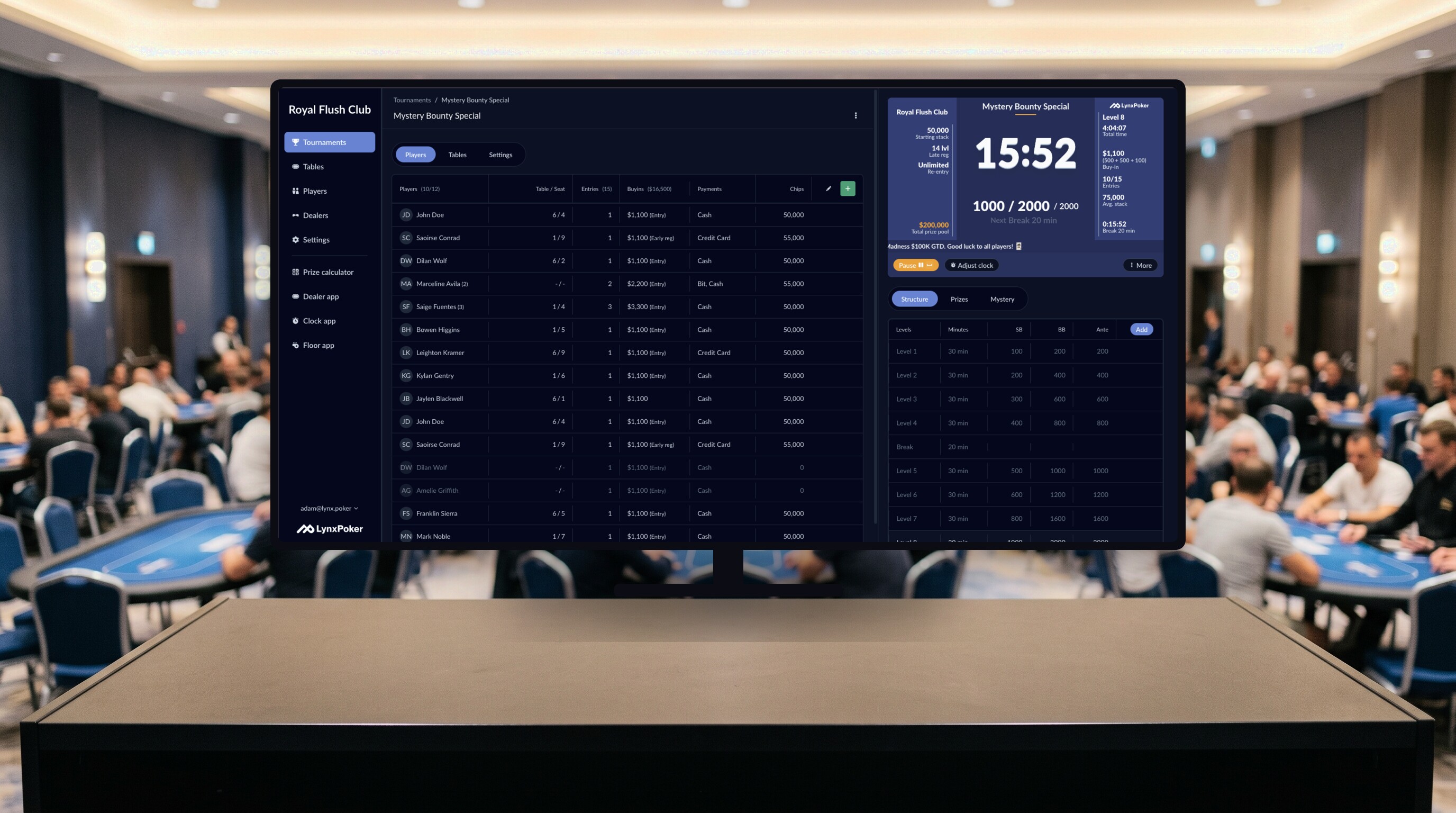
The best poker tournament software for a club in 2026 is a cloud platform built for multi-table operations — real-time sync across your whole staff, dealer and floor tools, and a database that remembers your regulars from one event to the next. A home-game timer with more seats won't cut it. For most clubs that means LynxPoker; if you run a large commercial room and want an established enterprise platform, LetsPoker is the alternative. Below is exactly what a club needs, and how the realistic options stack up.
Short answer: A poker club needs club software — multi-table real-time sync, a Floor App and Dealer App for staff, a real regulars database, recurring series and leaderboards, and branded player-facing displays — not a bigger clock. LynxPoker delivers all of it on every plan, with credits included: try it free for 3 tournaments, then Reg at $200 a month with 400 credits, Pro at $700 with 1,625, or Elite at $1,500 with 4,500, from 33¢ a player. Want every tool on the market compared head-to-head? See our full buyer's guide.
Why a poker club needs more than a home-game timer
A home game and a club look like the same game from the felt, but they are completely different operations to run. A home game is one table, one host, one phone propped against a bottle of wine. A club is three, five, ten tables running at once — with dealers rotating, a floor person fielding seat-change requests, regulars who expect you to know their name, and a series championship that has to track points across twelve Tuesdays. The software that quietly manages all of that is a different category of tool, and picking the wrong one shows up on the busiest night of your month. Here's what changes the moment you cross from home game to club, and why a timer app starts to crack:
- Multi-table operations. You're not watching one clock — you're running several tables that start, break, and balance together. Someone has to move players when a table gets short, and the whole room needs to be on the same blind level at the same second.
- Dealer rotations. Push-dealt clubs live or die on the rotation. Who's on box, who's on break, who pushes next — tracked on a whiteboard, this is chaos; tracked in software, it runs itself.
- Floor management. Seat changes, chip-race calls, table balancing, color-ups, disputes. Your floor person needs their own view of the room, not to lean over the clock every two minutes.
- A real player database. Not names in a group chat — a record of every regular, their buy-ins, re-entries, cashes, and history across every event you've ever run.
- Recurring series and leaderboards. Clubs run seasons, not one-offs. Points have to accumulate across events and a standings board has to stay honest all season long.
- Branded, player-facing displays. The clock on your wall is your storefront. It should carry your club's name and logo, show the prize pool and next blinds, and look like a real event — because it is one.
- Staff on multiple devices. The host on a phone, the floor on a tablet, the clock on a 65-inch TV — all showing the same truth, updating together, no refreshing and no discrepancies.
The tell that you've outgrown a timer: you're keeping the 'real' state of the tournament in your head and re-typing it into three places. Club software exists so the room has one source of truth that everyone — host, floor, dealers, and the screen on the wall — can trust at a glance.
The club software must-have checklist
If you're evaluating tools for a club specifically, these are the boxes that actually matter. (For the broad field — free clocks, desktop apps, enterprise platforms — start with our buyer's guide; this list is the club-grade subset.)
- Real-time multi-device sync. When the host registers a late entry on their phone, the floor's tablet and the TV update instantly — no manual refresh, no two versions of the truth.
- Dealer and floor management. Rotations, breaks, table assignments, seat changes, and a dedicated view for the person running the room on their feet.
- Player history and analytics across events. A regulars database that tracks buy-ins, re-entries, cashes, and results tournament after tournament — so you can see who your real regulars are and build events around them.
- Mystery bounty tools. The format that fills seats. You want bounty-pool management and an animated reveal on the screen, not envelopes and a spreadsheet.
- Transparent, published pricing. Prices you can see and budget against before you sign up — no per-event surcharges, no hidden fees, and no surprise invoice at your busiest time of year.
- Fast setup, no training. You should be able to onboard a new floor person in one night, not schedule a training session. If it needs a manual, it'll gather dust.
- Player-facing discovery. New to the checklist: a way for your regulars to find your events, follow the live clock, and register from their phone — so every tournament you run turns into demand for the next one.
The club options, honestly compared
Four tools come up again and again when clubs go shopping. Here's how they read against the club-specific criteria above — not a full feature audit (the buyer's guide has that), just the things that decide it for a multi-table room with staff and regulars. Competitor details are drawn from each product's public positioning; verify current specifics before you commit.
| What a club needs | LynxPoker | LetsPoker | Blind Valet | The Tournament Director |
|---|---|---|---|---|
| Real-time multi-table sync | ✅ | ✅ | ❌ | ❌ |
| Dedicated Floor + Dealer apps | ✅ | Partial | ❌ | ❌ |
| Regulars database across events | ✅ | ✅ | Partial | ✅ |
| Mystery bounty tools | ✅ | ✅ | ❌ | ❌ |
| Player app to discover & follow events | ✅ | ✅ | ❌ | ❌ |
| Runs on phone, tablet & TV (cloud) | ✅ | ✅ | ✅ | ❌ |
| Native Hebrew / RTL | ✅ | ❌ | AI only | ❌ |
| Prices published on its own site | ✅ | ✅ | ❌ | ✅ |
| Pricing model | Plans with credits, from $200/mo | €1 per player visit | Free to start, paid plans | $49.99 once (personal), Windows |
The short read (competitor prices checked on their own sites in October 2026; they may change): LetsPoker is the genuine enterprise option — a mature, two-sided platform with a real player app, built for large commercial rooms (its pricing page lists €1 per player visit, and you start by booking a demo). Blind Valet is excellent but aimed at home games and small leagues — a cloud clock with structure and league tools, light on dealer and floor operations. The Tournament Director is a deep, decade-proven Windows desktop app, but it's local-only: no cloud, no phones, no live sync between staff. LynxPoker is the one built for the modern club specifically — cloud, real-time, staff apps, a regulars database, plans with credits included. Which is right for you comes down to room size and budget; the buyer's guide goes deeper on each.
Go deeper on any tool
Why LynxPoker fits poker clubs specifically
Full disclosure: LynxPoker is our product. It's built by Adam Shriki — a semi-professional player with 20 years at the table and 15 years designing software — and it was designed around the club operation from day one, not scaled up from a solo timer. Here's what that means on a busy Saturday:
- Floor App + Dealer App. Your staff each get a purpose-built, web-based view — the floor sees seat changes and table balancing; dealers see the rotation and their next push. Both run in a browser on any device, so there's nothing to download and nothing to install on club hardware.
- Real-time WebSocket sync. Register a player, knock one out, or bump a blind level, and every connected device — host phone, floor tablet, the TV on the wall — updates in the same instant. One source of truth the whole room trusts.
- Cross-tournament player analytics. Every buy-in, re-entry, and finish rolls into a regulars database, so your leaderboards stay honest across a whole season and you can see who actually drives your room.
- Mystery bounty with an animated lottery-style reveal. Run the format that packs the room — bounty pools handled in software, and each prize revealed on the big screen with a lottery animation that gets the table roaring, instead of tearing open envelopes.
- Published plans with credits included. Free for your first 3 tournaments, then Reg at $200 a month with 400 credits, Pro at $700 with 1,625, or Elite at $1,500 with 4,500. One credit is one player in one tournament, and re-entries, rebuys and add-ons are free, so a big rebuy night uses no extra credits.
- Native Hebrew and RTL. Not a translation layer bolted on — the entire interface is built right-to-left from the ground up, which makes LynxPoker effectively uncontested for Israeli and Middle-Eastern clubs.
- A player app, live now. A free companion app on iOS and Android where poker players near you can discover your events, watch the live clock, follow chip counts and standings, and register from their phone. Every tournament you run becomes discoverable demand for the next one — unlike a static directory listing that goes stale the moment your structure changes.
Best for: multi-table clubs with staff and regulars, series and leaderboards, a brand on the wall — and anyone who needs dealer management, mystery bounty tools, or Hebrew, on pricing you can actually plan a whole season around.
Frequently Asked Questions
What software do poker clubs use?
Poker clubs typically use cloud tournament-management platforms rather than single-purpose timers, because a club runs multiple tables with staff and a database of regulars. The main options in 2026 are LynxPoker and LetsPoker (both cloud, real-time, staff-capable), with Blind Valet and The Tournament Director more common in home games and smaller leagues. LynxPoker is the value pick for most independent clubs; LetsPoker suits large commercial rooms that want an established enterprise platform.
What's the best tournament software for a poker club?
For most clubs, LynxPoker is the best fit: it's built specifically for multi-table operations with a dedicated Floor App and Dealer App, real-time sync across every device, a regulars database with cross-event analytics, mystery bounty tools, and published plans with credits included (a free trial, then from $200 a month, from 33¢ a player). LetsPoker is the stronger choice if you operate a large commercial card room and want its established enterprise platform.
Do poker clubs need dealer management software?
If you run three or more tables with push dealers, yes — dealer management stops being optional. Tracking who's on box, who's on break, and who pushes next on a whiteboard falls apart on a busy night. Dedicated dealer tools handle the rotation automatically. It's surprisingly rare in poker software: LynxPoker offers a purpose-built, web-based Dealer App, while most timer-style tools have no dealer features at all.
How much does poker club software cost?
It ranges from free to enterprise. LynxPoker sells plans with credits included, after a free trial of 3 tournaments: Reg is $200 a month with 400 credits, Pro $700 with 1,625, Elite $1,500 with 4,500, and Legend is custom. One credit is one player in one tournament, so it works out from 33¢ a player, and re-entries, rebuys and add-ons are free. The Tournament Director lists a $49.99 one-time personal license and a $299.99-a-year commercial license, but it is Windows-only with no cloud. LetsPoker's pricing page lists €1 per player visit. (Competitor prices checked October 2026; they may change.) For a club, the number that matters is total cost on your biggest night — with LynxPoker, re-entries and rebuys never add to it.
Can one platform run multiple tables at the same time?
Yes — that's exactly what club software is for. A cloud platform like LynxPoker keeps every table on the same blind level in real time, lets you balance and break tables as the field shrinks, and shows the whole room's state on any device at once. This is where home-game timers break down: they're built to run a single clock, not a coordinated multi-table event with staff on several screens.
What's the difference between poker club software and a home-game timer?
A home-game timer runs one clock for one table and one host. Club software runs an operation: multiple tables synced together, dealer and floor tools, a regulars database that persists across events, recurring series with leaderboards, and branded player-facing displays. The rule of thumb — if more than one person on your staff needs to see or change the tournament state at the same time, you've outgrown a timer and need club software.
Keep reading
Ready to run your club like a real event? Start free at lynx.poker — set up your first multi-table tournament, put your branded clock on the wall, and see why clubs are switching. No credit card, no training required.
Join the newsletter
Product updates, tournament playbooks, and seasonal promotions. Usually once or twice a month, no spam.