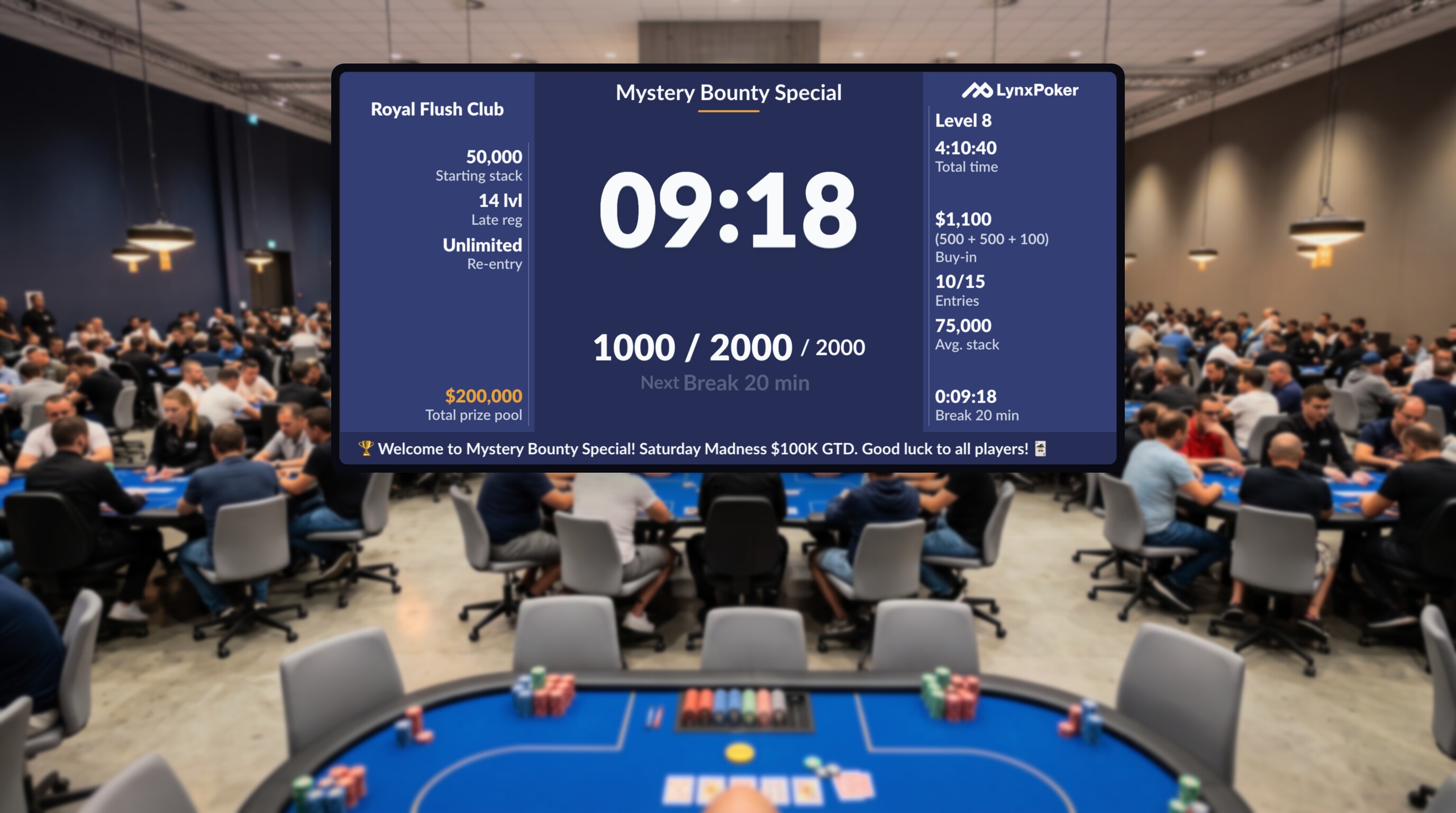
How to Run a Mystery Bounty Tournament (Director Guide)
A tournament director's guide to running a mystery bounty: how to split the buy-in, build the bounty tiers, run a fair draw, and reveal each hit to the room.
A mystery bounty tournament is a format where part of every buy-in funds a separate bounty pool, and each time you knock a player out during the bounty phase you draw a random, sealed prize — anything from a small minimum up to a life-changing jackpot. Most players think about it as a strategy question. As the director, it's an operations question: how you split the buy-in, how you build the bounty tiers, how you make the draw genuinely random and visibly fair, and how you reveal and pay out every hit in front of a room full of people who came for exactly that moment.
Short answer — to run a mystery bounty: (1) split each buy-in into a prize pool and a bounty pool, (2) divide the bounty pool into sealed envelopes — many small, a few large, one jackpot — that sum to exactly the pool, (3) decide when bounties go live, (4) draw a random envelope on each elimination during the live phase, (5) reveal it to the table and log who won what, then (6) reconcile and pay out. Doing this on paper works at 20 players and falls apart at 200 — which is where mystery-bounty software earns its keep.
The format went from a WSOP novelty to a fixture on club schedules in about two years, and for good reason: it turns every elimination into a spectacle instead of a quiet handshake. But that same drama is what makes it a headache to run. A regular knockout bounty is a flat number you pay on the spot. A mystery bounty is a lottery you have to fund precisely, draw fairly, reveal theatrically, and reconcile to the cent — while the tournament clock keeps running. This guide walks the whole thing from the director's chair.
What a Mystery Bounty Tournament Is, From the Operator's Seat
Strip away the excitement and a mystery bounty is two prize pools stapled to one tournament. The first is the ordinary prize pool that pays the final tables the way any tournament does. The second is the bounty pool: a pot of money broken into sealed prizes, one of which gets drawn at random each time a player busts during the live-bounty phase. The entrant who busts doesn't win the bounty — the player who eliminated them does. That's the whole hook: you don't know what you're playing for until you knock someone out and open the envelope.
For you, that means you're not just running a clock and a payout ladder anymore. You're running a raffle in parallel — with real cash, a public draw, and a crowd watching to make sure it's clean. Everything that follows is about making that raffle balance, stay fair, and land as a moment rather than a mess.
The prize pool rewards the player who lasts the longest. The bounty pool rewards the player who does the knocking out. A good mystery bounty makes both of those feel worth showing up for.
How the Format Actually Works Operationally
The two pools
Every buy-in gets divided before the cards are in the air. A common structure on a $200 event is $100 to the regular prize pool and $100 to the bounty pool, with rake taken out separately and disclosed up front. The exact split is your call, but the guiding principle is that the bounty pool should be big enough to fund a jackpot people talk about, without gutting the top-heavy payouts that reward deep runs. Whatever you choose, publish it before registration opens — players want to know what fraction of their money is going where.
The randomized draw
The bounty pool is split into sealed units — physical envelopes, tickets in a drum, or a digital equivalent — one prize per unit. When an elimination triggers a bounty, one unit is selected at random and revealed. The two non-negotiables are that the selection is truly random and that everyone can see it is. If the room suspects the jackpot envelope somehow never comes out until the house's favorite regular is dealing the beat, you've lost the format. Randomness you can demonstrate is worth more than randomness you can only promise.
The prize tiers
The bounty pool isn't paid out evenly — that would be boring. You build a distribution: a large number of minimum-value bounties, a shrinking number of bigger ones, and a single jackpot that dwarfs the rest. The math constraint is absolute: the number of envelopes multiplied by their values has to sum to exactly the bounty pool you collected, no more and no less. Here's a worked example for a 100-entrant event with $100 per player going to the bounty pool — a $10,000 pool across 100 envelopes:
| Bounty tier | Envelopes | Value each | Pool total |
|---|---|---|---|
| Minimum | 70 | $50 | $3,500 |
| Standard | 20 | $100 | $2,000 |
| Big | 7 | $250 | $1,750 |
| Premium | 2 | $500 | $1,000 |
| Jackpot | 1 | $1,750 | $1,750 |
| Total | 100 | — | $10,000 |
Notice that most envelopes just return the minimum — that's intentional. The occasional dud is what makes the jackpot electric. Your job is to shape a curve that pays out honestly while keeping the tail heavy enough that one draw can change someone's night.
How to Run a Mystery Bounty, Step by Step
Step 1 — Decide the buy-in split
Fix three numbers before you announce the event: how much of the buy-in is rake, how much funds the prize pool, and how much funds the bounty pool. A 50/50 split between the two pools is the popular default, but a smaller bounty portion keeps the format friendlier to deep-run players, while a larger one leans into the lottery. Write it down, put it on the structure sheet, and don't change it once registration is open.
Step 2 — Set when bounties go live
Bounties almost never start from hand one. Most directors activate them at a set point — after late registration closes, at a specific level, or once the field has shrunk to a chosen number. Delaying activation does two things: it keeps early, casual busts from burning through envelopes before the drama builds, and it concentrates the reveals into a tighter, more engaged field. Pick the activation trigger deliberately and tell the room exactly when the bounties turn on.
Step 3 — Build the bounty tier distribution
Design the curve like the table above: a big block of minimum envelopes, a few mid tiers, and one jackpot. Two rules keep you out of trouble. First, the envelope count should match how many eliminations you expect during the live-bounty phase — if you'll have roughly 90 busts after activation, don't print only 40 envelopes. Second, everything has to sum to the exact pool. If you guarantee a minimum value on every envelope, multiply that minimum by the envelope count first and make sure the pool covers it before you add the bigger tiers on top.
Step 4 — Set up the draw mechanic
Choose how a bounty gets selected and how it gets revealed. On paper that's sealed, identical, shuffled envelopes stored where no one can feel for the fat one, drawn in full view of the busting player and the winner. Digitally it's a random selection your software makes and shows on screen. Either way, decide in advance who does the draw (usually the floor, not the winning player), where it happens, and how a disputed reveal gets handled. Ambiguity here is what turns a fun night into an argument.
Step 5 — Handle eliminations and reveals
When a bounty-phase elimination happens, the flow is: confirm the knockout and who gets credit for it, pause to draw, reveal the prize, and log it. Credit is the tricky part — decide up front how you handle a hand where two short stacks bust on the same deal, or an all-in that splits. Reveal small bounties fast so the game keeps moving, and save the theater for the big ones. When the jackpot finally comes out, stop the room and let it be an event. That single reveal is the story players will tell about your tournament.
Step 6 — Reconcile and pay out
Keep a running ledger of every bounty drawn: which player won it, which tier, and how much. At the end you should be able to show that the sum of all bounties paid equals the bounty pool collected, with any undrawn envelopes accounted for (some events roll leftovers into the final bounty or the prize pool — decide and disclose that policy in advance). Pay bounties in whatever form you committed to — cash on the spot or settled at cashout — and hand each winner a record they can keep.
Step 7 — Display it for the room
The bounty structure shouldn't live only in your head. Put the tier breakdown, the number of jackpots remaining, and the activation status somewhere the whole room can see — ideally on the same big screen that shows the clock and blinds. Visibility does two jobs: it builds anticipation (players can watch the jackpot count tick down), and it proves the game is being run straight. A mystery bounty that's a black box feels rigged even when it isn't.
Common Pitfalls (And How to Avoid Them)
- ❌ Funding math that doesn't balance — the single most common mistake. If your envelope values don't sum to exactly the collected pool, you either owe money you don't have or you're quietly keeping change that belongs to players. Reconcile the distribution to the cent before you print a single envelope.
- ❌ Too few envelopes — if you print fewer bounties than the number of bounty-phase eliminations, you run out mid-tournament and have to improvise in front of an annoyed room. Estimate busts generously and match your envelope count to it.
- ❌ A draw that isn't visibly fair — envelopes of different thickness, a drum the floor reaches into blind, a screen only you can see. Any of these lets suspicion in. Make the mechanic transparent and repeatable.
- ❌ Ignoring record-keeping and tax rules — bounty winnings can be reportable, and requirements vary widely by country, state, and whether you're a licensed venue or a home game. This is jurisdiction-dependent; keep a clean audit trail of who won what, and check your local rules or an accountant before you run a big one.
- ❌ Pacing the reveals badly — revealing every $50 minimum with full ceremony grinds the game to a halt, while rushing the jackpot wastes the best moment you've got. Fast for small, theatrical for big.
- ❌ Undefined re-entry and split-pot rules — decide before the event whether a re-entry adds another bounty to the pool and how credit works when two players bust on one hand. Sort it in the structure sheet, not at the table.
How Software Makes Running a Mystery Bounty Painless
Everything above is doable by hand for a 20-person Sunday game: a stack of envelopes, a shoebox, and a notebook. At 100-plus players it becomes a genuine job. You're printing and stuffing envelopes, guarding them, tracking which are drawn, credited, and paid, reconciling the ledger while the clock ticks, and hoping your handwritten count matches the cash at the end. One miscount and you're doing forensic accounting at 2 a.m. instead of shaking hands with your winner.
This is exactly the kind of chore management software exists to absorb. LynxPoker has built-in mystery-bounty tools: you configure the bounty pool, define the tier distribution, and set the activation point, and the system handles the randomized draw and the running ledger for you. On each qualifying elimination it plays an animated lottery-reveal on the tournament display — the whole table watches the prize spin up rather than squinting at an envelope in someone's hand. The math balances automatically, the record is kept for you, and the moment that makes the format worth running gets the stage it deserves.
The reveal is the product. A paper draw is a private moment between two players; an animated reveal on the big screen turns every knockout into something the whole room leans in for — and turns the jackpot hit into the clip people share afterward. That shared, on-screen moment is the practical reason to run the format on software instead of by hand.
To be straight about the landscape: LynxPoker isn't the only platform that supports mystery bounty. LetsPoker, an established and credible competitor, offers the format too, and if you're already running on it you can absolutely host a solid mystery bounty. The distinction we'd point to isn't that we invented the format or run it 'better' across the board — it's the animated reveal moment itself, built to be watched by the room on the main display. Evaluate both and pick the one whose reveal experience and workflow fit how your events actually feel on the floor.
Frequently Asked Questions
What is a mystery bounty tournament?
It's a tournament with two prize pools: a normal prize pool that pays the final finishers, and a separate bounty pool broken into sealed, randomized prizes. During the bounty phase, each time you eliminate another player you draw a random prize — usually a small minimum, but sometimes a large one or a single jackpot. The player doing the eliminating wins the bounty, and the amount is a mystery until it's revealed.
How do you structure the bounty prizes?
You build a tier distribution: a large number of minimum-value bounties, a smaller number of mid-tier prizes, and a single jackpot that's much larger than the rest. The number of envelopes times their values must sum to exactly the bounty pool you collected. A typical shape is roughly 70% minimum envelopes, a couple of mid tiers, and one jackpot worth a significant slice of the pool — enough that a single draw can change someone's night.
How much of the buy-in goes to the bounty pool?
That's the director's choice, but a 50/50 split between the regular prize pool and the bounty pool is the common default — for example, $100 to each on a $200 buy-in, with rake handled separately. A smaller bounty portion keeps the payouts friendlier to deep runs; a larger one leans harder into the lottery feel. Whatever you pick, publish the split before registration opens so players know where their money goes.
When do the bounties go live in a mystery bounty?
Rarely from the first hand. Most directors activate bounties at a set trigger — after late registration closes, at a specific blind level, or once the field shrinks to a chosen size. Delaying activation stops early casual eliminations from draining envelopes before the drama builds, and concentrates the reveals into a smaller, more engaged field. Announce the exact activation point so everyone knows when the knockouts start paying.
What software runs mystery bounty tournaments?
LynxPoker has built-in mystery-bounty tools that handle the pool configuration, tier distribution, activation point, randomized draw, and running ledger, and play an animated lottery-reveal on the tournament display for each qualifying knockout. LetsPoker also supports the format. Running a mystery bounty at scale by hand — printing and stuffing envelopes, tracking draws, reconciling the ledger — is error-prone above roughly 100 players, which is the practical reason most directors reach for software once their fields get big.
What records should you keep for a mystery bounty?
It depends entirely on your jurisdiction and the nature of your event — country, state or region, and whether you operate as a licensed venue or a private home game all matter. Because the rules vary so widely, the safe practice is to keep a clean record of every bounty won (player, amount, and date) and to check your local requirements or consult an accountant before running a large event. Treat this as general operational guidance, not tax advice.
Can you run a mystery bounty at a small home game?
Yes, and it's a great way to add energy to a regular game. At small numbers you can genuinely do it with paper — sealed, identical envelopes, a fixed split, and a clear draw everyone can see. The format only becomes a logistical burden as the field grows and the reconciliation and reveals pile up, which is the point at which software starts saving you real time and preventing costly counting mistakes.
Keep reading
Running your first mystery bounty? Let the software handle the funding math, the fair draw, and the reveal so you can run the room. Start free with LynxPoker and set one up in minutes.
Join the newsletter
Product updates, tournament playbooks, and seasonal promotions. Usually once or twice a month, no spam.