How to Run a Poker Tournament: The Complete Guide (2026)
Run a poker tournament start to finish: format, buy-in, blinds, payouts, table balancing, and when software beats paper. A 20-year player's 2026 guide.
Running a poker tournament comes down to six moving parts: a format and buy-in, a starting stack and blind structure, a payout ladder, a clock everyone can see, enough chips and tables, and a plan for the live logistics — eliminations, table balancing, breaks, and paying the winners. Nail those and the night runs itself. This is the complete lifecycle, from the decisions you make a week out to the last handshake at the final table, written from both sides of the felt.
The short version — to run a poker tournament: (1) Plan — choose a format, set the buy-in and prize pool, and pick a starting stack, a blind structure, and a payout ladder. (2) Set up — seat players by a random draw, hand out equal starting stacks, and start the clock. (3) Run it — manage levels and breaks, balance and break tables, log eliminations and re-entries, color up chips, and close registration. (4) End it — play down to a final table, then heads-up, then pay out (and settle any deal). A single-table home game needs only paper and a phone timer; as players, tables, and staff grow, tournament software starts earning its keep.
I've spent twenty years on the player's side of that table — buying into events up to $5k across more than thirty countries under the name CabesaBlanco — and the last few building the tools directors run on. So this guide is opinionated where it should be and honest about where the shortcuts are. Let's run one.
A tournament is just a schedule of rising blinds wrapped around a payout ladder. Everything else — the drama, the bad beats, the champion — is what happens when you run that schedule cleanly.
Step 1: Plan the Tournament
Every good tournament is decided before a single card is dealt. The plan is a handful of numbers — buy-in, stack, blinds, payouts — that together determine how long the night runs, how deep the play feels, and how happy people are when they leave. Get them internally consistent and you've done ninety percent of the work.
Pick a format and a buy-in
Start with the shape of the event. The format sets the tone and the budget; the buy-in tells players how seriously to take it. Whatever you choose, decide your rake or fee up front — the cut the house keeps to cover cards, dealers, and the room — and state it publicly. A common recreational structure is a small fixed fee per entry (say $10–20 on a $100 buy-in) with the rest going straight into the prize pool. Players forgive a fee they can see; they resent one they discover at payout.
- Freezeout — one buy-in, one bullet. Bust and you're out. The purest and simplest format, ideal for a first event.
- Re-entry / rebuy — bust during a set early window and buy a fresh stack (re-entry) or top up your existing one (rebuy). Grows the prize pool and keeps the room full early.
- Add-on — a one-time optional chip top-up, usually offered at the first break to everyone still seated.
- Bounty / knockout — part of each buy-in becomes a cash prize for eliminating another player, paid on the spot.
- Mystery bounty — a bounty variant where each knockout draws a random sealed prize, from a small minimum up to a jackpot. A production, not just a payout.
- Satellite — awards seats (entries) into a bigger event instead of cash. Great for feeding a flagship tournament.
- Multi-day — the field plays down over two or more sessions, bagging and tagging chips at the end of each day. For larger fields and marquee events.
Choose a starting stack and blind structure
Starting stack and blinds are two halves of one decision: how much play do you want? Express the stack in big blinds, not chips — a 20,000 stack at 50/100 blinds is 200 big blinds, which is deep; the same stack at 100/200 is 100 big blinds, which is standard. More starting big blinds and longer levels mean more poker and a longer night. For a club event, 100–150 big blinds to start with 20-minute levels is a comfortable middle. Turbos run 15-minute (or shorter) levels; deepstacks run 30–45 minutes.
The blind structure is the schedule of increases. Each level should rise smoothly — roughly 25–50% per level — with no jarring jumps that suddenly put the whole room all-in. Modern structures use a big blind ante (a single ante posted by the big blind each hand instead of an ante from every player), which speeds the game up and removes a whole category of dealer error. Write the full ladder on a structure sheet, print it, and put a copy on every table.
A quick sanity check on length: total chips in play, divided by the average stack you want survivors to have at the final table, tells you roughly how many big blinds they'll be playing — and your level chart tells you when they'll get there. If the math says the final table starts at 12 big blinds, your levels are too fast or your stacks too short. Lengthen levels or deepen stacks before the event, never during it.
Set the payouts, late registration, and re-entries
Decide how many places pay before you open registration. A widely used rule of thumb is to pay roughly the top 10–15% of the field — so a 60-player event pays about 7–9 spots. The payout curve is top-heavy on purpose: first place should be worth chasing, but the min-cashes should still feel like a reward for surviving the bubble. One nuance worth knowing: tournament chips are not cash. Because of the payout structure, a big stack's chips are worth less per chip in real money than a short stack's — that's the Independent Chip Model (ICM), and it's why final-table deals are negotiated on ICM value, not raw chip counts.
Late registration keeps the room full and the prize pool growing; it usually stays open for the first several levels — commonly through level 6 to 8, often the same window in which re-entries are allowed. Publish exactly when it closes, because that moment changes the game: the field size locks, the prize pool is final, and you can post the confirmed payout ladder. If you're running re-entries, decide in advance whether a re-entered player draws a new random seat and how a re-entry affects any bounty pool.
Line up the venue, equipment, and staff
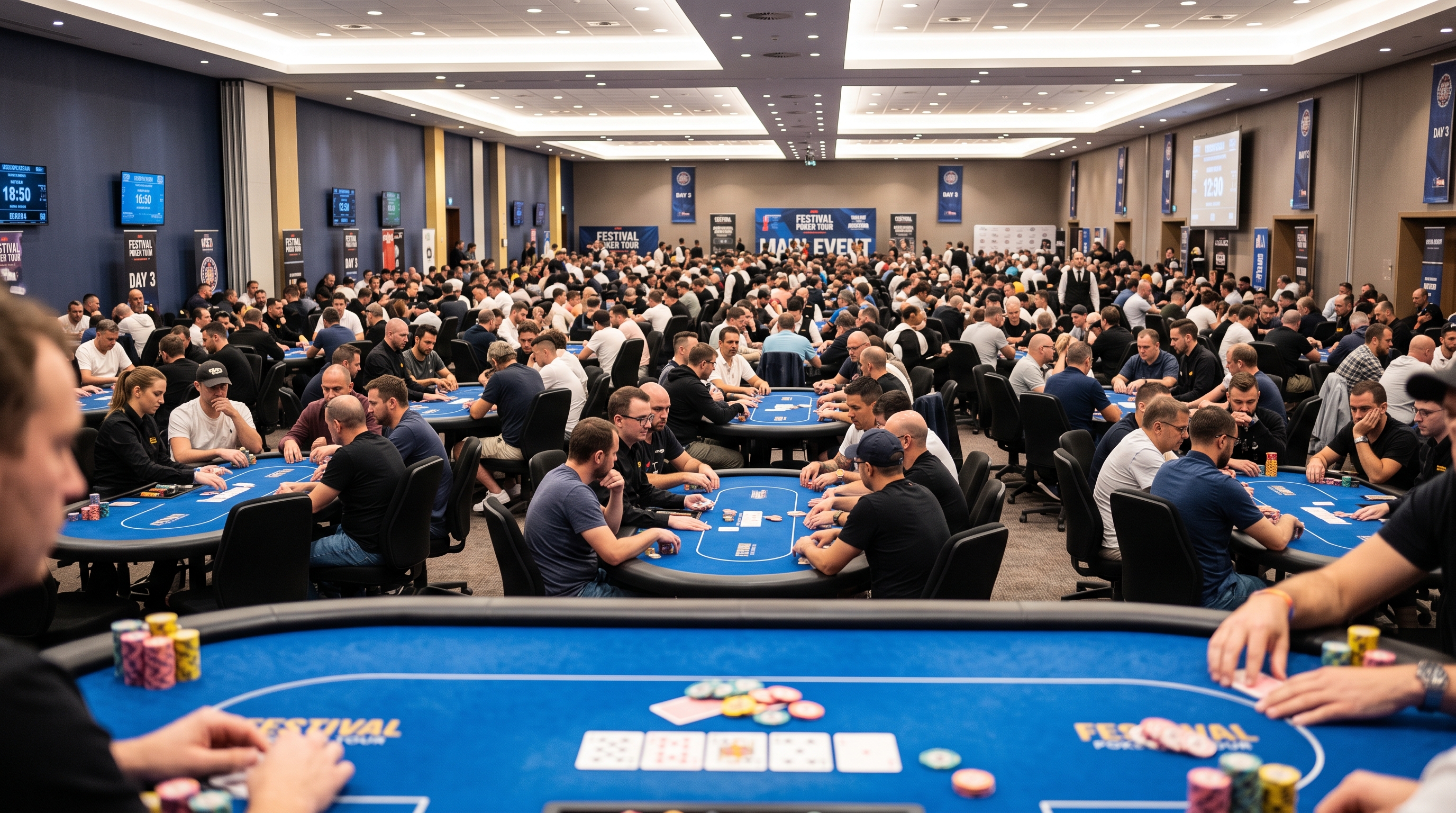
Now the physical side. A standard poker table seats up to nine or ten, so a 60-player event needs seven tables with a little slack. Beyond tables you need chips in enough denominations to cover the whole structure without a shortage of any color, at least two decks per table (one in play, one being shuffled), a dealer button and blind markers per table, and a big screen or TV for the clock. For anything past a couple of tables, staff matter as much as gear.
- Chips — enough of each denomination for the full blind ladder, with room to color up as the small chips leave play.
- Cards — two decks per table, ideally plastic, rotated between hands.
- Buttons and markers — a dealer button per table, plus small/big blind and all-in markers if you use them.
- The clock — a visible countdown showing the level, blinds, ante, next level, and time remaining. This is the heartbeat of the room.
- Staff for bigger events — a tournament director to make rulings, dealers if you're not self-dealing, and a floor person to manage seating, breaks, and disputes.
Step 2: Set Up on the Day
The setup window is the half hour before cards go in the air, and it's where a calm night is won or lost. Three things have to be true by start time: every seat has the right chips, every player has a random seat, and the clock is ready to run.
Distribute the starting stacks and draw for seats first. Count out identical stacks at each seat before players arrive, or hand a chip rack to each entrant as they check in. Seating must be random — pull seat cards, use a randomizer, or let your software assign seats — never let friends pick their table. A clean random draw is both fairer and faster, and it's the first thing an experienced player looks for as a sign the event is run properly. Post a seating list so people can find their table and seat number without asking you twice.
Then set the clock and the screen. Load your blind structure, set the level length and break schedule, and confirm the first level's blinds and ante match the structure sheet. Whatever players stare at all night should show the current blinds, the ante, the time left in the level, the next level's blinds, and — as the field shrinks — the number of players remaining and the payouts. A big, legible clock on a TV does more for the feel of an event than almost anything else you can buy; a laptop screen turned sideways on a chair does not.
Step 3: Run It During Play
Once the cards are in the air your job shifts from planning to flow control. You're keeping the clock honest, keeping tables balanced, logging what happens, and making the occasional ruling. None of it is hard; all of it is easier with a system.
Levels, breaks, and table balancing
Let the clock drive the levels — when it hits zero, blinds go up on the next hand, not mid-hand. Schedule a short break every few levels (a 5–10 minute break every 90–120 minutes is typical), and use the first break as the add-on and last-re-entry moment if your format has one. The recurring live task is table balancing: as players bust, keep every table within one player of the others by moving people to fill empty seats. When a table gets short enough, break it entirely and distribute its players to the open seats around the room. Two rules keep balancing fair — move the player who is next to post the big blind (so nobody pays blinds twice or skips them), and break tables in a predetermined order everyone can see.
Eliminations, re-entries, add-ons, and color-ups
Log every elimination as it happens — it drives the remaining-players count, the average stack, and the moment you hit the money. During the re-entry window a busted player can buy back in; after it closes, out is out. Process add-ons at the break in one batch. As the blinds climb, the smallest chip denominations stop being useful and clutter the table, so you color up: remove the small chips and replace their value with larger ones. When the total doesn't divide evenly, run a chip race — deal one card per leftover small chip, and the highest cards win the odd chips rounded up to the next denomination — so no value quietly disappears. Do color-ups at the break when you can; they're much faster with the room paused.
Dealers, the floor, and TDA rules
At a couple of tables you can self-deal and make your own rulings. Past that, dealers and a floor person keep the game clean and on time. Dealers typically rotate tables on a schedule — often every half hour or at each break — to spread out skill and keep anyone from grinding at one table all night. When a dispute or an unusual situation comes up, it's a floor call: play pauses, the floor listens, and the floor decides. Most serious events run on the Tournament Directors Association (TDA) rules, the widely adopted standard rulebook — adopting them means you're not inventing procedure on the fly and players already know what to expect. If you run staff, note that the Floor App and Dealer App are web-based — no download — so a floor person or dealer just opens a tablet and works.
Closing registration and the bubble
When late registration and re-entries close, announce it, lock the field, and post the final prize pool and payout ladder. From there the whole room is playing toward one line: the money. The bubble is the last player eliminated before the payouts begin — the most tense stretch of any tournament. Many directors play hand-for-hand on the bubble (every table plays one hand at the same pace) so no one can stall their way into the money while another table is forced to act. The moment the bubble bursts, everyone still seated is in the money (ITM), and the mood in the room changes completely.
Special Formats Worth Knowing
Once you're comfortable with a standard freezeout, a few formats are worth adding to your calendar. The mystery bounty is the crowd favorite right now: part of each buy-in funds a pool of sealed, randomized prizes, and every knockout in the bounty phase draws one — a small minimum most of the time, occasionally a jackpot that changes someone's night. It's the most fun you can put on a schedule and the most operationally involved, because you're running a fair, balanced raffle in parallel with the tournament.
Satellites award seats into a bigger event instead of cash, which is how festivals feed their flagship — one seat for every N buy-ins, and you stop the moment the last seat is locked. Multi-day events bag and tag chips at the end of each session and resume with the same stacks, letting a big field play down over a weekend. Both add logistics, but neither is complicated once you've run a clean single-day event first.
Step 4: End the Tournament
The end of a tournament is where the memories are made, so run it deliberately. As the field collapses toward the last table, the pace naturally slows and the stakes rise every hand.
When you reach the final table, many events pause to formally introduce the finalists, confirm the remaining payouts, and — for bigger events — consolidate onto a featured table with a clock everyone can watch. Play continues until two players remain, and then it's heads-up. Two things change heads-up: the button posts the small blind and acts first before the flop but last after it, and the blinds keep climbing, so it rarely lasts long. When the last hand is over, you have a champion.
Then pay out. Work down the ladder — the player who busts in each paid spot collects that spot's prize — and pay in whatever form you committed to, whether cash on the spot or a settled cashout. Keep a clean record of who finished where and what they were paid; it protects you if a question comes up later, and it's the raw material for your next event's marketing and any leaderboard you run.
One thing comes up at almost every final table: a deal. When the money left is life-changing relative to the buy-in and a few players are close in chips, they may want to chop the remaining prize pool rather than gamble it out. The fair way to run a deal is by ICM — pay each remaining player the cash value of their current chip stack, usually leaving a little on top for first place and the trophy — not by splitting evenly or by raw chip proportion. Run the numbers, get every remaining player to agree out loud, and only then adjust the payouts. Never let a deal happen off the books at the table.
By Hand or by Software? An Honest Take
You do not need software to run a poker tournament. A printed structure sheet, a countdown timer on a phone, a notepad for eliminations, and a bit of attention will run a single-table home game perfectly well, and there's something to be said for the simplicity. If that's your whole event, stop reading and go deal — you're set.
Software starts earning its keep the moment the manual version gets fiddly: a second and third table to keep balanced, a prize pool that changes with every re-entry, chip races to reconcile, dealers to rotate, a bubble to play hand-for-hand, and a clock that has to stay visible and correct at all times. Doing that on paper is possible; doing it while also making rulings and greeting players is where mistakes creep in. The real question isn't 'clock or software' — it's 'at what size does the paperwork stop being worth my attention on the floor.'
| Option | What it is | Where it fits |
|---|---|---|
| Paper + phone timer | A printed structure sheet and a countdown app | A single-table home game where nothing needs to sync |
| Ultimate Holdem Timer | A free, no-account browser clock | When you just want a clean timer with zero setup |
| Blind Valet | A tidy cloud tournament clock, home-game oriented | Recreational games that want a nice structure and clock |
| The Tournament Director | The deep, highly configurable Windows desktop benchmark | Power users on a dedicated PC who want control over every setting |
| LetsPoker | An established enterprise/festival platform with a player app; its pricing page lists €1 per player visit (checked October 2026, may change) | Large commercial card rooms and festival series |
| LynxPoker | A modern multi-device platform — smart clock, unlimited tables, dealer and floor tools and native Hebrew/RTL on every plan, free to try | Home games growing into clubs, and clubs and festivals that want modern software without heavy training |
I'll be straight about where LynxPoker fits, because I built it. Twenty years of buying into events left me staring at the same clock crashing at the same final table, run on software that felt stuck in 2005 — ugly where it faced players, complex and training-heavy where it faced organizers. LynxPoker is the fix I wanted: a modern tournament platform for directors, clubs, and festivals that runs in the browser across phones, tablets, and the TV, syncing in real time over the whole room. The free trial is a genuine on-ramp — 3 tournaments within 14 days, up to 150 players each, with every feature on: a cast-to-TV smart clock, a blind-structure builder, a prize customizer, dealer and floor management, and built-in mystery bounty. After that, plans include credits, from Reg at $200 a month with 400 credits to Elite at $1,500 with 4,500; one credit is one player in one tournament, and re-entries, rebuys and add-ons are free. It's also the only platform with native Hebrew and RTL built in from the start.
There's also a free player app, out now on iOS and Android, that lets people discover nearby tournaments, follow the live clock and chip counts and standings, and register from their phone. For a director that's not a nicety — it's how the players in your area find your room, and the clock they follow at home is the same clock you're running on the floor. The competitors in the table above are all legitimate options; choose on how your events actually feel on the night, not on a feature checklist.
Rule of thumb: if you can run your event from a single notepad without losing track, paper is fine. The moment you're reconstructing a chip race from memory or arguing about who owes what at 1 a.m., the software has already paid for itself.
Compare your options
Scaling Up: From Home Game to Club
A lot of clubs started as somebody's monthly home game that outgrew the kitchen. The jump from a recurring private game to a real club is less about poker and more about consistency — a fixed schedule, a repeatable structure, dealers and floor staff, a way for players to find you, and books that balance. If that's the direction you're heading, plan the operational side deliberately rather than letting it sprawl, and lean on the same systems that keep a single event clean.
Keep building
Frequently Asked Questions
How do I run a poker tournament?
Plan it, set it up, run it, and end it. Planning means choosing a format and buy-in, a starting stack and blind structure, and a payout ladder. Setup means seating players by a random draw, distributing equal starting stacks, and starting a visible clock. Running it means managing levels and breaks, balancing and breaking tables as players bust, logging eliminations and re-entries, coloring up chips, and closing registration. Ending it means playing down to a final table, then heads-up, then paying out the winners in order. A single-table home game needs only paper and a phone timer; larger events benefit from tournament software.
What do I need to run a poker tournament?
At minimum: poker tables (one seats up to nine or ten), enough chips in several denominations to cover your blind structure, at least two decks of cards per table, a dealer button and blind markers, a visible tournament clock, and a printed blind structure and payout ladder. For events past a couple of tables you also want staff — a tournament director to make rulings, dealers, and a floor person to handle seating, breaks, and disputes. The clock is the one piece you shouldn't skimp on; it's what the whole room runs on.
How long should poker tournament blind levels be?
It depends on how much play you want. Turbo events use 15-minute (or shorter) levels; a comfortable club structure runs 20–30 minutes; deepstack and major events run 30–45 minutes or more. Longer levels and a deeper starting stack mean more poker and a longer night. Whatever you pick, the blinds should increase smoothly — roughly 25–50% per level — with no sudden jumps that put the whole room all-in at once.
How many places should pay in a poker tournament?
A common rule of thumb is to pay roughly the top 10–15% of the field — so about 6–9 spots in a 60-player event. The payout curve should be top-heavy enough that first place is worth chasing, while still rewarding the players who survive the bubble with a min-cash. Decide the number of paid places before registration opens, and post the confirmed payout ladder once late registration closes and the field is locked.
How do I handle table balancing?
Keep every table within one player of every other table as people bust. When a seat opens, move the player who is next to post the big blind into it, so nobody pays blinds twice or skips them. When a table gets short enough, break it entirely and send its players to the open seats elsewhere, breaking tables in a predetermined order the room can see. Balancing by hand is manageable at two or three tables and gets error-prone beyond that, which is where software that assigns the moves for you saves real time.
What software do I need to run a poker tournament?
None, strictly — a printed structure sheet and a phone timer will run a single-table home game. Software earns its place as you add tables, re-entries, chip races, dealers, and a bubble to manage. Options range from a free browser clock like Ultimate Holdem Timer, to a tidy cloud clock like Blind Valet, to the deep Windows desktop benchmark The Tournament Director, to enterprise festival platforms like LetsPoker. LynxPoker is a modern multi-device platform you can try free for 3 tournaments — a cast-to-TV smart clock, a blind-structure builder, unlimited tables, dealer and floor management, and mystery bounty, on every plan.
How much starting stack should players get?
Think in big blinds, not chips. A stack of 100–150 big blinds at the opening level is a comfortable, playable default for a club event; 200+ big blinds is a deepstack; anything under about 50 is a turbo that will play fast. The exact chip number matters less than the ratio to the opening blinds and how your levels climb from there — a 20,000 stack is deep at 50/100 and standard at 100/200. Match the stack depth to how long you want the tournament to last.
How do I run a mystery bounty tournament?
Split each buy-in into a normal prize pool and a separate bounty pool, then divide the bounty pool into sealed, randomized prizes — many small, a few large, one jackpot — that sum exactly to the pool. Decide when bounties go live (usually after late registration closes), and on each knockout in the bounty phase draw a random prize for the eliminator and reveal it. Keep a ledger so the bounties paid reconcile to the pool collected. It's very doable on paper at a small game and becomes a real job above roughly 100 players, which is where mystery-bounty software helps. See our full mystery bounty guide for the funding math and tier tables.
Keep reading
- Poker blind structure guide (with ready-to-run ladders)
- Poker tournament payout structure (how to split the prize pool)
- How to run a mystery bounty tournament
- The best poker tournament management software (2026 buyer's guide)
- Free poker tournament clock: blind presets, breaks and TV mode
- Run the free poker tournament clock in your browser
- The complete dealer management guide
- From home game to poker club
- See how LynxPoker runs the whole tournament
Ready to run your next one on a clock that won't quit at the final table? Try LynxPoker free for 3 tournaments: a cast-to-TV smart clock, a blind-structure builder, and a prize customizer — no credit card — set up your first tournament in minutes and cast it to the biggest screen in the room.
Join the newsletter
Product updates, tournament playbooks, and seasonal promotions. Usually once or twice a month, no spam.